We've Tested ChatGPT Ads: Here's What You Should Know
As one of the first agencies to test ChatGPT Ads, we asked our PPC expert to share his insights and early observations from the platform.
For years, Google Ads and social media have dominated the digital advertising landscape. Now, a new player has arrived.
Following OpenAI’s introduction of advertising within ChatGPT in early 2026, businesses have started exploring what this new channel could mean for their marketing strategies. While it’s still in its early stages, ChatGPT Ads represent one of the biggest changes to digital advertising since the rise of AI-powered search.
At CMe Automotive, we’re among the first agencies to test ChatGPT Ads. We’ve been exploring how the platform works, where ads appear, and whether it has the potential to become a valuable addition to existing paid marketing campaigns.
What are ChatGPT Ads?
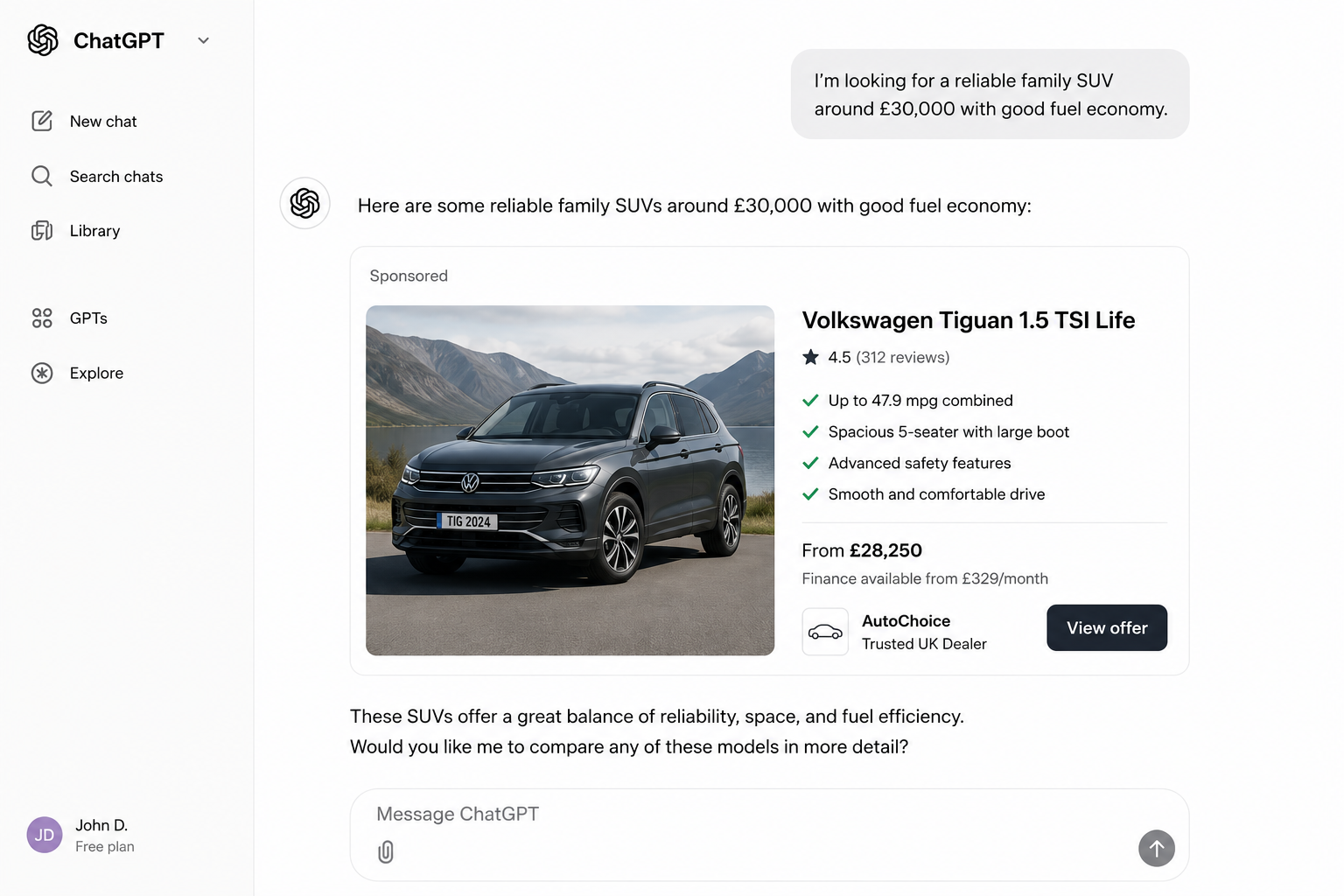
ChatGPT Ads are sponsored placements that appear within relevant conversations on ChatGPT. Rather than displaying alongside search engine results like Google Ads, they appear when users are actively asking questions, researching products or services, or looking for recommendations.
The ads are clearly labelled as sponsored content and are kept separate from ChatGPT’s AI-generated responses. Instead of interrupting the conversation, they’re designed to complement it by introducing relevant businesses at the point where users are exploring their options.
It’s a very different approach from traditional PPC and reflects the way people are increasingly using AI to research before making purchasing decisions.
Why has OpenAI launched advertising?
The way people search online is changing.
Millions of users are now turning to AI assistants instead of traditional search engines to compare products, ask for advice and discover new brands. As AI becomes a bigger part of the customer journey, it creates new opportunities for businesses to connect with potential customers.
For advertisers, ChatGPT offers access to an audience that’s already engaged in detailed, high-intent conversations. Rather than targeting someone based on a short search query, businesses can potentially reach users while they’re still researching and considering their options.
How are ChatGPT Ads different from Google Ads?
The biggest difference is intent.
Google users typically search with short, keyword-focused queries. ChatGPT users, on the other hand, tend to ask complete questions and expect detailed, conversational answers.
Unlike Google Ads, there are no keywords to bid on. Instead, advertisers simply describe the audience they want to reach using a prompt, such as “I am a car dealer and want to sell Audi cars in Hampshire.” ChatGPT then decides when the advert is relevant enough to appear.
According to Petar Nikolov, our PPC Specialist:
"The platform is much simpler than Google Ads at the moment. When we first launched our campaign, you could only add a headline, description, image and destination URL. Even within a few weeks, OpenAI introduced audience uploads, conversion events and product feeds, so it's evolving extremely quickly."
Petar Nikolov
While campaigns are easy to build, reporting is still fairly limited. Unlike Google Ads, advertisers currently can’t see the prompts or conversations that triggered their adverts, making optimisation more challenging.
How are ChatGPT Ads different from Google Ads?
At the moment, ChatGPT Ads appear to be best suited to larger businesses with a national audience.
Our expert believes larger automotive retailers and finance companies are among the businesses most likely to benefit, mainly because UK targeting is currently limited to a national level.
"Location targeting in the UK is still very limited. If you're a local business trying to reach customers in one town or county, it isn't ideal yet. Larger dealerships and finance companies are likely to see more value until more granular targeting becomes available."
Petar Nikolov
In the United States, advertisers can already target cities, suggesting more advanced location targeting could arrive in the UK in the future.
What results can businesses expect?
As with any new advertising platform, it’s still too early to define clear performance benchmarks.
Current campaigns are more focused on increasing visibility and engagement than delivering predictable lead volumes. One limitation is that advertisers cannot see which prompts caused their adverts to appear, making performance analysis less detailed than with Google Ads.
Current benchmarks include:
- Average cost per click of around £2
- Minimum campaign budget of £15 per day
- National targeting only within the UK
- Limited reporting compared to more established PPC platforms
When asked when ChatGPT Ads could replace Google Vehicle Ads, Petar said:
"Definitely not at the moment. At least, not in its current form. We need to see how the platform evolves, but with features like product feeds already being introduced, it's going to be interesting to watch over the next few months. It's still too early to say whether it could replace Google Vehicle Ads."
Petar Nikolov
For now, Google Vehicle Ads remain the stronger option for retailers looking to showcase live vehicle stock, while ChatGPT Ads offer an opportunity to reach customers earlier in their research journey.
Pros and cons of ChatGPT Ads
Like any new advertising platform, there are both advantages and limitations.
PROS
CONS
- Be one of the first businesses to advertise on an emerging platform.
- Less competition than established advertising channels.
- New features are being released at a rapid pace.
- Simple campaign setup.
- Limited targeting options in the UK.
- Basic reporting and analytics.
- No visibility of the prompts that triggered adverts.
- The platform is still evolving, with many features yet to be introduced.